Key points
- Japan's battery aggregators sort into four provider types: utility-affiliated majors, aggregation specialists, software platforms, and owner-operators. The question is fit — not which type is "best."
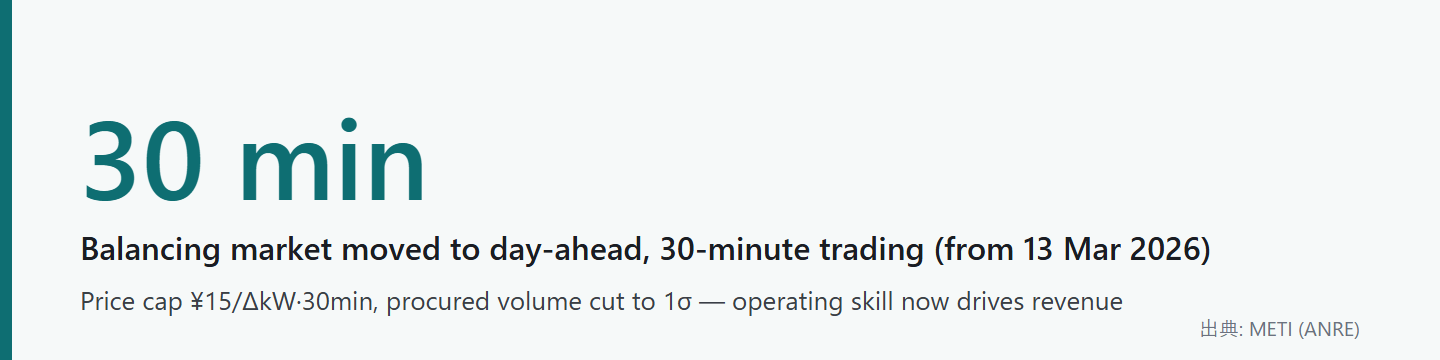
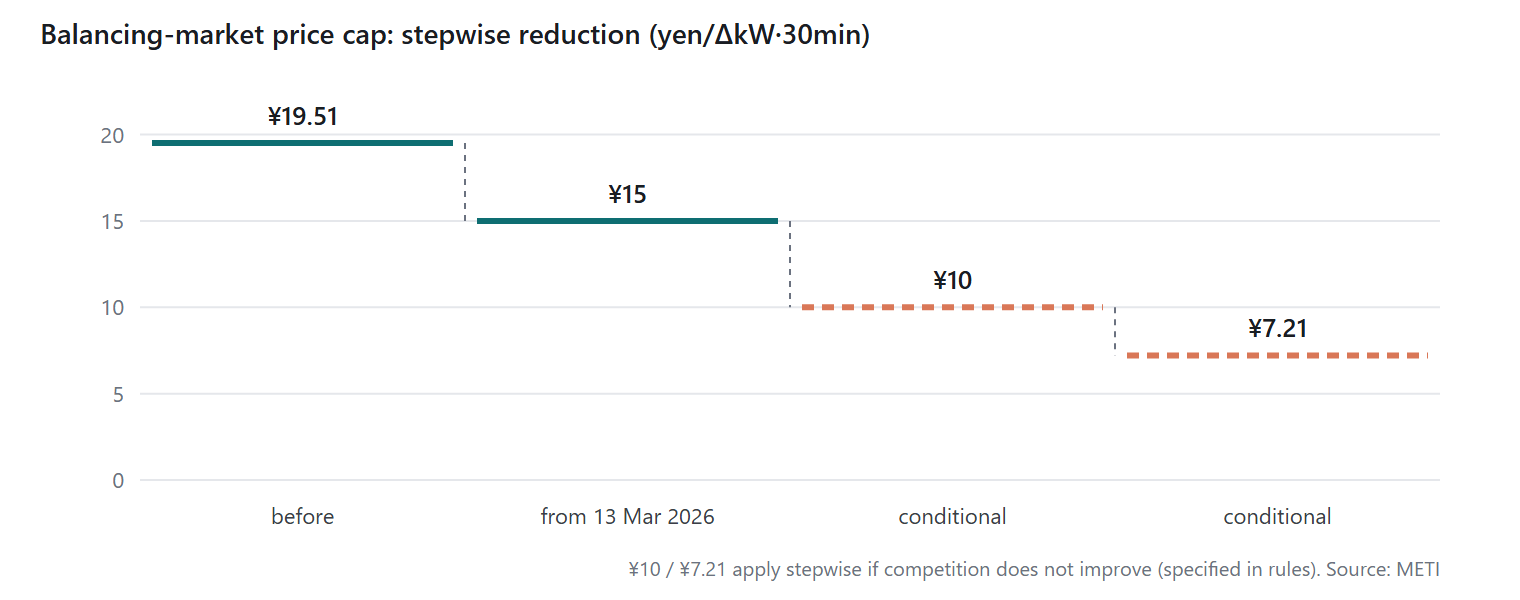
- Since the 13 March 2026 balancing-market overhaul (day-ahead 30-minute trading, price cap cut to ¥15/ΔkW·30min, procured volume reduced to a 1σ basis — source: METI), the operating skill of your aggregator directly drives revenue.
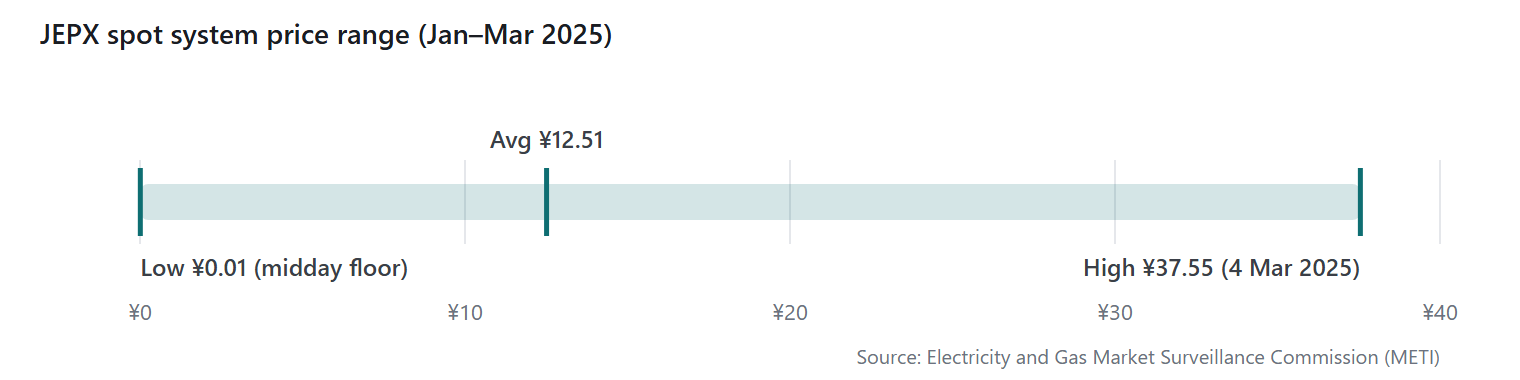
- JEPX spot prices ranged from ¥0.01 to ¥37.55/kWh (avg ¥12.51) in Jan–Mar 2025 (source: Electricity and Gas Market Surveillance Commission) — how much of that spread you capture depends on who operates your asset.
- The fastest way to compare providers: send all candidates the same 15 RFI questions in this article and line up the answers.
- Disclosure: LehmanSoft Japan is itself an owner-operator type aggregator. This article does not rate named competitors; it gives you the map and the questions.
1. What you are actually outsourcing
"Using an aggregator" means three different things depending on the contract. The chain runs: price forecasting → operation planning → market bidding and scheduling → charge/discharge control → settlement and reporting. Who does which part is the dividing line.
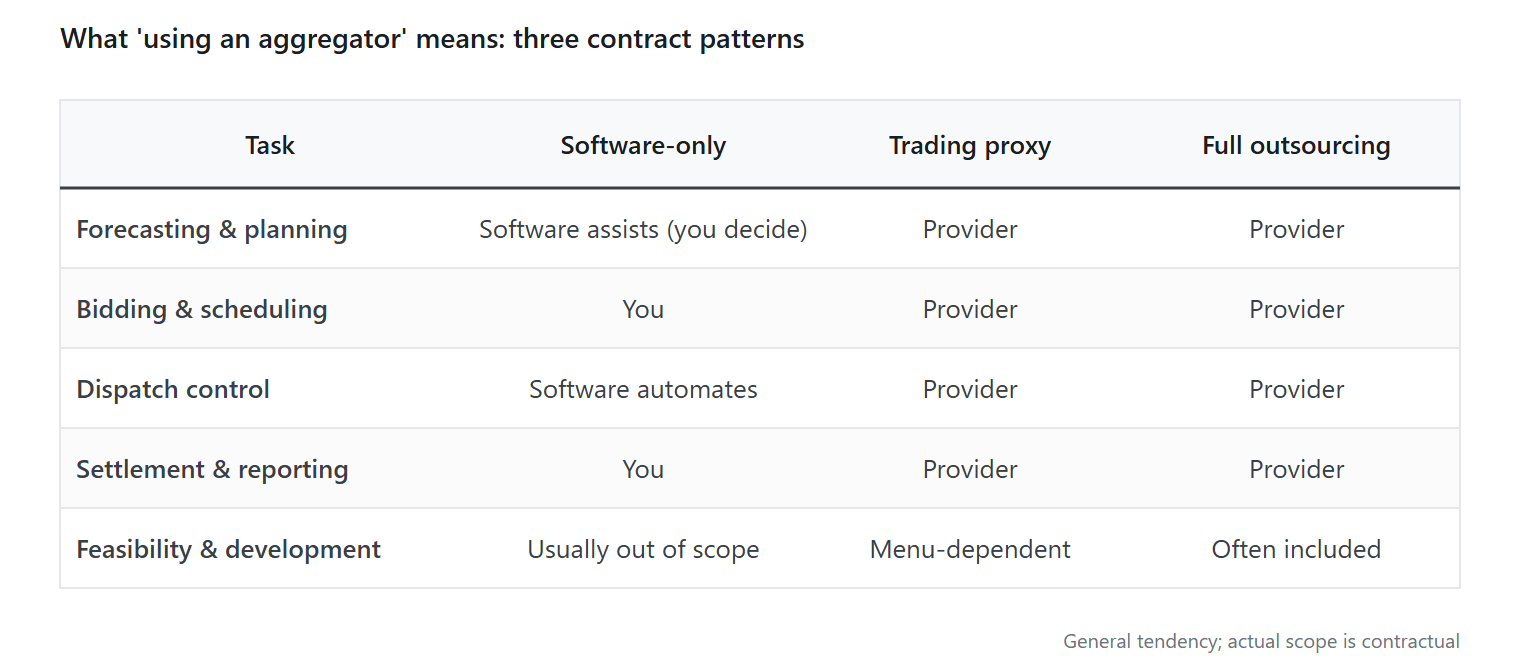
In Japan's regulatory framework, a Resource Aggregator (RA) bundles and controls the assets, while an Aggregation Coordinator (AC) faces the markets and the grid operator on behalf of RAs. Ask first: which roles does your counterparty actually hold, and who is the trading entity?
2. The March 2026 overhaul raised the bar for operators
From the 13 March 2026 trading day, the balancing market (primary through tertiary①) moved to day-ahead, 30-minute trading, with the price cap cut and procured volume reduced (source: METI).
Meanwhile the JEPX spot market still offers a wide intraday spread — value that only disciplined multi-market operation captures.
The era of parking a battery in one market is over. Slot-by-slot allocation across markets, decided daily, is now the revenue driver — which makes the choice of operating partner part of your revenue model. Details of the overhaul: Japan's 2026 balancing market overhaul.
3. The landscape: who publicly offers what
For orientation, here are major players that have publicly announced battery aggregation / operation services. This is a sample, not an exhaustive list; order is by type, not ranking. All facts are from each company's own public announcements as of June 2026 (per our linking policy we do not link to external corporate sites).
| Company | Type | Publicly announced |
|---|---|---|
| JERA Cross | Utility-affiliated major | Battery operation-outsourcing service announced Feb 2026: dispatch optimization, market trading, administration, feasibility studies; extra-high and high voltage (company announcement) |
| Tokyo Gas | Utility-affiliated major | Grid-battery optimization service announced Mar 2025; first mandates of two stations totaling 165MW; 800MW under operation targeted by FY2030 (company announcement); high-voltage offering announced Dec 2025 |
| E-Flow (Kansai Electric group) | Utility-affiliated major | Founded 2023 as a dedicated market-operation company; has announced grid-battery operation mandates and multi-use operation |
| ENERES (KDDI group) | Aggregation specialist | Grid-battery control-support service (system + market entry and operations support) on its official pages; also serves FIP-co-located batteries (company announcement) |
| Digital Grid | Aggregation specialist | Battery aggregation service from operation planning through bidding, scheduling and dispatch instructions; high and extra-high voltage (company announcement) |
| Shizen Energy group (Shizen Connect) | Software platform | Provides AC/RA systems; adoption as the RA system of a major domestic aggregator announced Nov 2025 |
| NTT Anode Energy | Owner-operator | "Build-and-operate" full-service offering announced May 2025 (launched July 2025); has announced its own rollout plan of 23 stations / 300MWh+ (company announcement) |
| LehmanSoft Japan (us) | Owner-operator | Operates its own 2MW/8MWh station in Chichibu, Saitama via AI-VPP (commercial since Nov 2025); JEPX trading; balancing-market entry Mar 2026; two station projects sold |
4. Four provider types — and which fits whom
Type, not brand, is the first sorting decision.
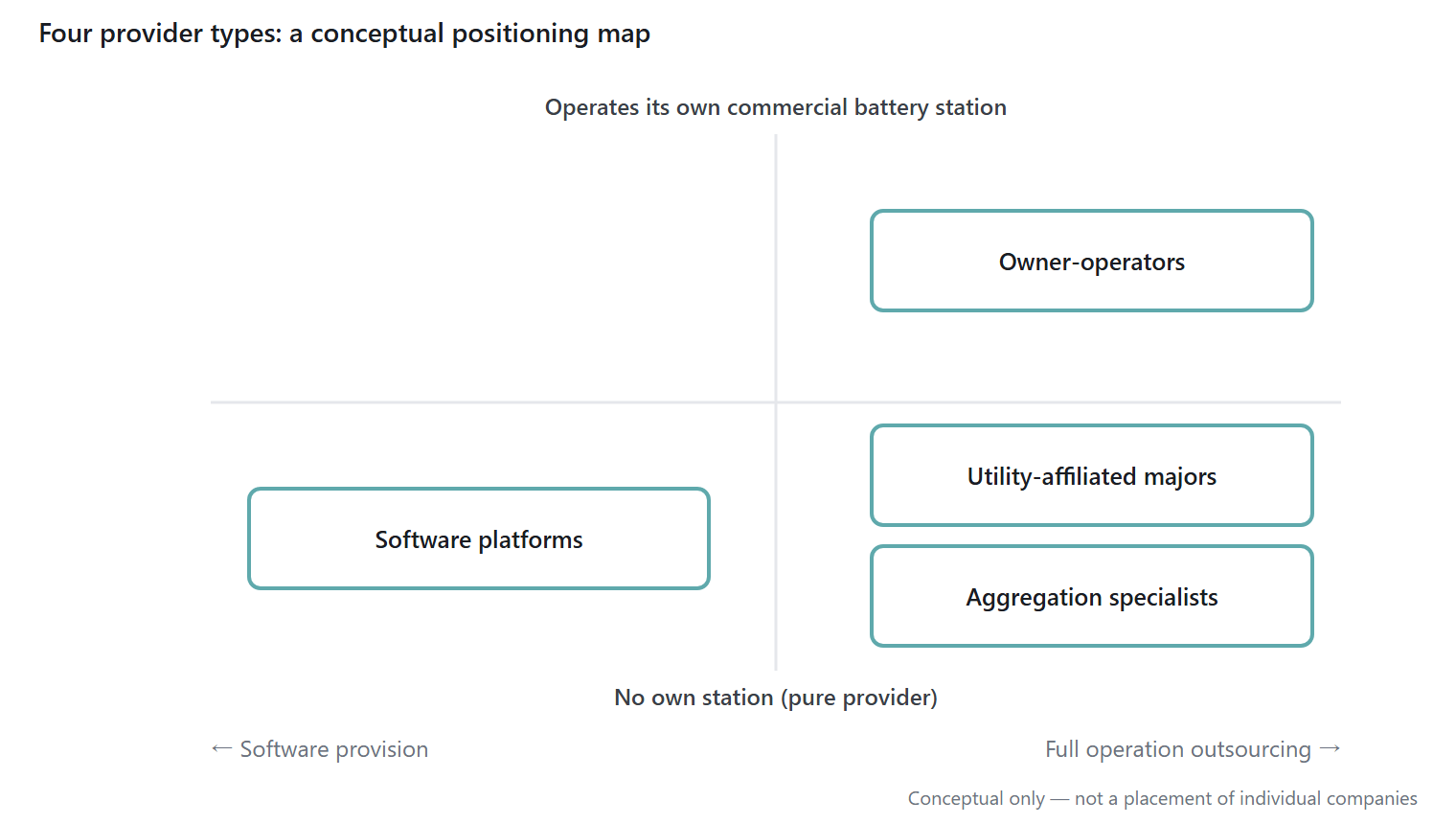
| Aspect | Utility-affiliated majors | Aggregation specialists | Software platforms | Owner-operators |
|---|---|---|---|---|
| Typical offering | Full package from feasibility to trading and administration | One-stop proxy: bidding, scheduling, dispatch | Forecasting/bidding/control software (you operate) | Operating know-how proven on their own plant |
| Typical scale focus | Extra-high voltage, tens of MW | High to extra-high voltage | Any scale — if you can staff operations in-house | Varies by provider, down to single MW-class sites |
| Source of strength | Group trading desks and balance-sheet credibility | Specialist execution and well-defined service menus | Algorithm quality and iteration speed | Skin in the game — they run their own P&L on a real plant |
| Trading entity | The aggregator | The aggregator | The software is not a trading entity — you must design this | The aggregator |
| What to verify | Priority given to single, smaller sites | Whether they have run their own assets commercially | Whether you can sustain an in-house operations team | Scale of own-operation track record and support depth |
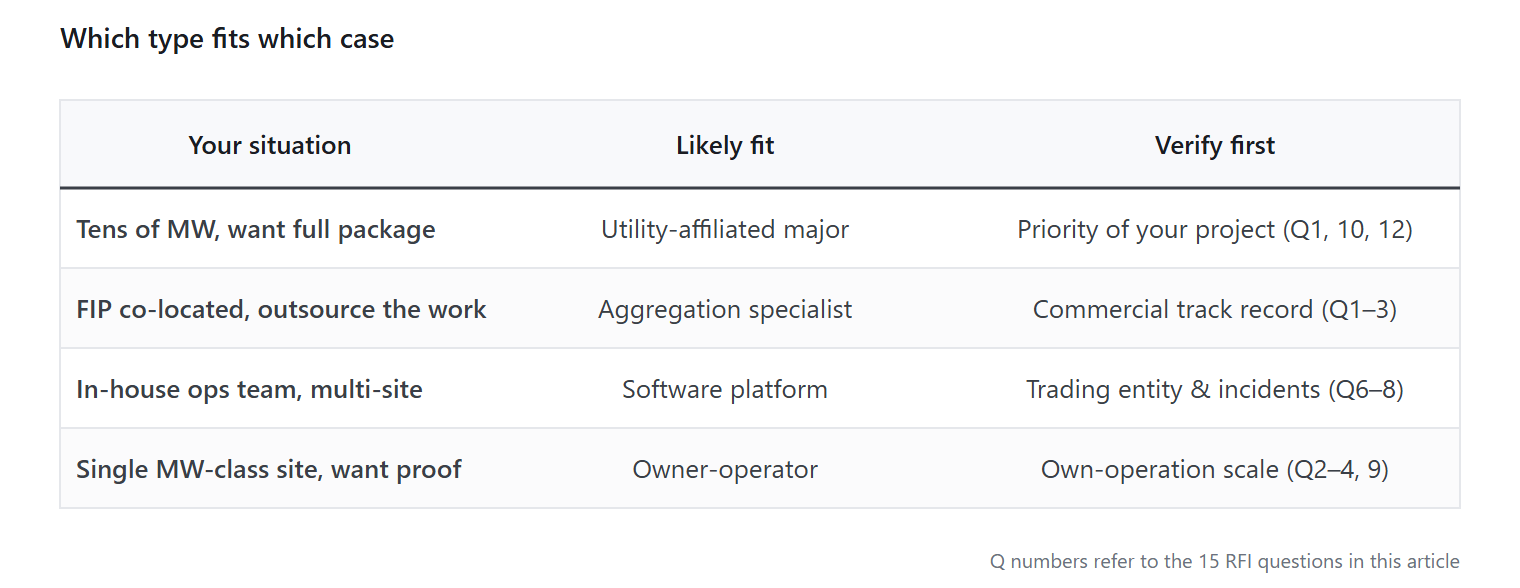
5. The 15 RFI questions
Send all candidates the same questions in the same format, and put the answers side by side. A refusal or a vague answer is itself comparison data.
Track record (Q1–4)
- How many battery stations are you operating commercially today (not pilots) — owned and contracted, in MW/MWh — and since when?
- Do you operate a battery station you own, at your own P&L risk? Are its location and capacity public?
- Which JEPX products (spot, intraday) and balancing-market products are you actually bidding into and clearing today, and since when for each?
- What did you change in your operations and systems in response to the March 2026 balancing-market overhaul? Give one concrete example.
Forecasts and systems (Q5–6)
- For your revenue projection, will you disclose the assumptions in writing — the market-price data period used, whether the regulatory basis is current rules, and how round-trip efficiency, degradation and auxiliary losses are reflected?
- Are your forecasting, bidding and control systems built in-house or sourced externally? If external, who handles rule-change modifications and first-line incident response?
Responsibility and incidents (Q7–8)
- Who bears imbalance charges and balancing-market assessment penalties, under what conditions? Can we review the relevant contract clauses before signing?
- If operation stops due to a communications outage, a system failure, or a battery-side fault — where does responsibility sit in each case, and is monitoring/recovery 24/7?
Reporting and money (Q9–11)
- Please share a sample monthly report before contracting. Does it include revenue by market, charge/discharge results per 30-minute slot, and state-of-charge history?
- Can we also receive the raw operating and trading data (CSV or similar)?
- What is the fee calculation base (before or after imbalance and market fees)? What is included in any fixed portion, and is there a fee-revision clause?
Exit terms (Q12–15)
- What are the contract term and early-termination conditions, including penalties? What happens if the contract ends for your reasons (business exit or transfer)?
- At contract end, who owns the operating and trading data, and in what format is it handed over?
- How is your state-of-charge policy (depth of discharge, cycling) reconciled with the battery maker's warranty conditions — and who is responsible for keeping them aligned?
- If we sell the station or transfer equity, can the operation contract be assigned? Will you support the sale with operating-record data?
6. Where we stand
As disclosed at the top, LehmanSoft Japan is one of the owner-operator type aggregators. Public facts: we operate our own 2MW/8MWh grid-scale station in Chichibu, Saitama via AI-VPP (commercial operation since November 2025), trade on JEPX, entered the balancing market in March 2026, and have sold two station projects.
The 15 questions above are the ones we believe any operating partner — ourselves included — should be able to answer. Our own answers are reflected in how to choose an operation partner in Japan, and you can run a first-pass revenue estimate for your project in our revenue simulator.
Conclusion
- Pick the two or three provider types that fit your project and team, then verify the landscape facts against each company's own primary announcements.
- Send the 15 RFI questions to all candidates in the same format; require a draft contract and a sample monthly report before signing.
- Get the revenue assumptions in writing (current-rule basis), and keep your own estimate — our revenue simulator gives a first pass.
Related: Japan's 2026 balancing market overhaul and multi-market operation / How grid-battery revenue works in Japan
References
- Agency for Natural Resources and Energy (METI), "On the Balancing Market" (13 May 2026) (https://www.meti.go.jp/shingikai/enecho/denryoku_gas/jisedai_kiban/stable_power_supply_wg/pdf/001_08_00.pdf)
- Organization for Cross-regional Coordination of Transmission Operators (OCCTO), Balancing Market Review Subcommittee FY2025 report (16 March 2026) (https://www.occto.or.jp/assets/chousei_117_04.pdf)
- Electric Power Reserve eXchange (EPRX), Balancing Market Explanatory Material, 2nd ed. (13 March 2026) (https://www.eprx.or.jp/outline/docs/kaisetsu.pdf)
- Electricity and Gas Market Surveillance Commission (METI), Market monitoring report for Jan–Mar 2025 (https://www.egc.meti.go.jp/activity/emsc_systemsurveillance/pdf/010_10_00.pdf)
- METI, Battery and Power-Source Industry Strategy (2 June 2026) (https://www.meti.go.jp/press/2026/06/20260602001/20260602001.html)
Based on public information as of 10 June 2026. The landscape table is illustrative, not exhaustive; service details change — verify against each company's primary announcements. If you find a factual error, we will review and correct it promptly. This is not investment advice.