Key points
- According to Japan's Electricity and Gas Market Surveillance Commission (EGC), the monthly average cleared price of tertiary reserve 2 (all areas) was ¥1.88–4.09/ΔkW·30min in April–September 2026. The simple average over the six months is about ¥2.61.
- The combined market, which trades primary through tertiary reserve 1 together, ran at ¥2.64–3.15 a month, with a six-month simple average of about ¥2.88.
- From delivery on 1 September 2026, the price cap for primary reserve, secondary reserve 1 and the combined market fell from ¥15 to ¥10. Secondary reserve 2 and tertiary reserve 1 stay at ¥7.21, and tertiary reserve 2 has no cap. Combined-market monthly averages stayed below a third of the new ¥10 cap.
- Differences between areas are large. Tokyo's tertiary-2 monthly average rose to ¥11.85 in May but was ¥0.68 in September (1–10 September). In August, the highest cleared price in Chubu reached ¥97.00.
- Estimate battery revenue from actual cleared prices, not from the price cap. A model that assumes ¥15 is pricing in about 5.7 times the actual tertiary-2 average.
Summary
According to material published by the Electricity and Gas Market Surveillance Commission on 29 September 2026, cleared prices in Japan's balancing market in April–September 2026 averaged ¥1.88–4.09/ΔkW·30min a month for tertiary reserve 2 (all areas) and ¥2.64–3.15 for the combined market. The combined market's monthly averages were below a third of the price cap, which fell to ¥10 in September. When estimating battery revenue, start from actual cleared prices rather than the cap, and assume large differences between areas and swings from month to month.
1. Cleared prices in April–September 2026: tertiary-2 averaged ¥1.9–4.1 a month
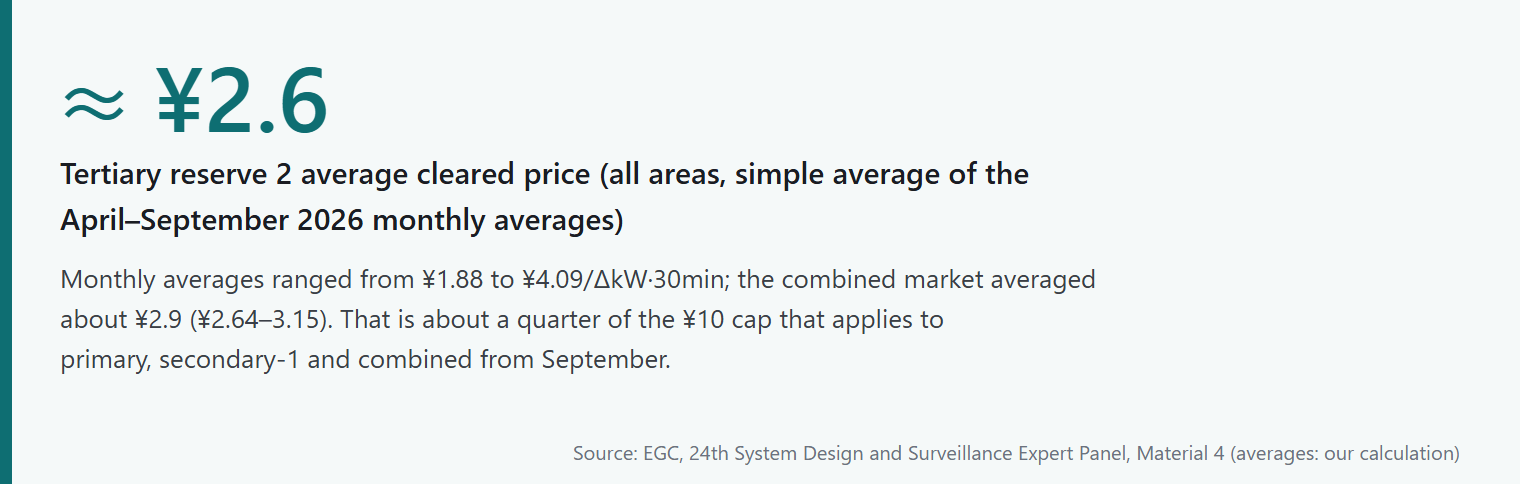
At the 24th meeting of its System Design and Surveillance Expert Panel (制度設計・監視専門会合) on 29 September 2026, the Electricity and Gas Market Surveillance Commission (EGC) reported on the balancing market from 1 April to 10 September 2026. Using data from the Electric Power Reserve eXchange (EPRX), the report sets out monthly average cleared prices, estimated procurement costs and cleared volumes for tertiary reserve 2 (三次調整力②, "tertiary-2" below) and for the combined market (複合市場).
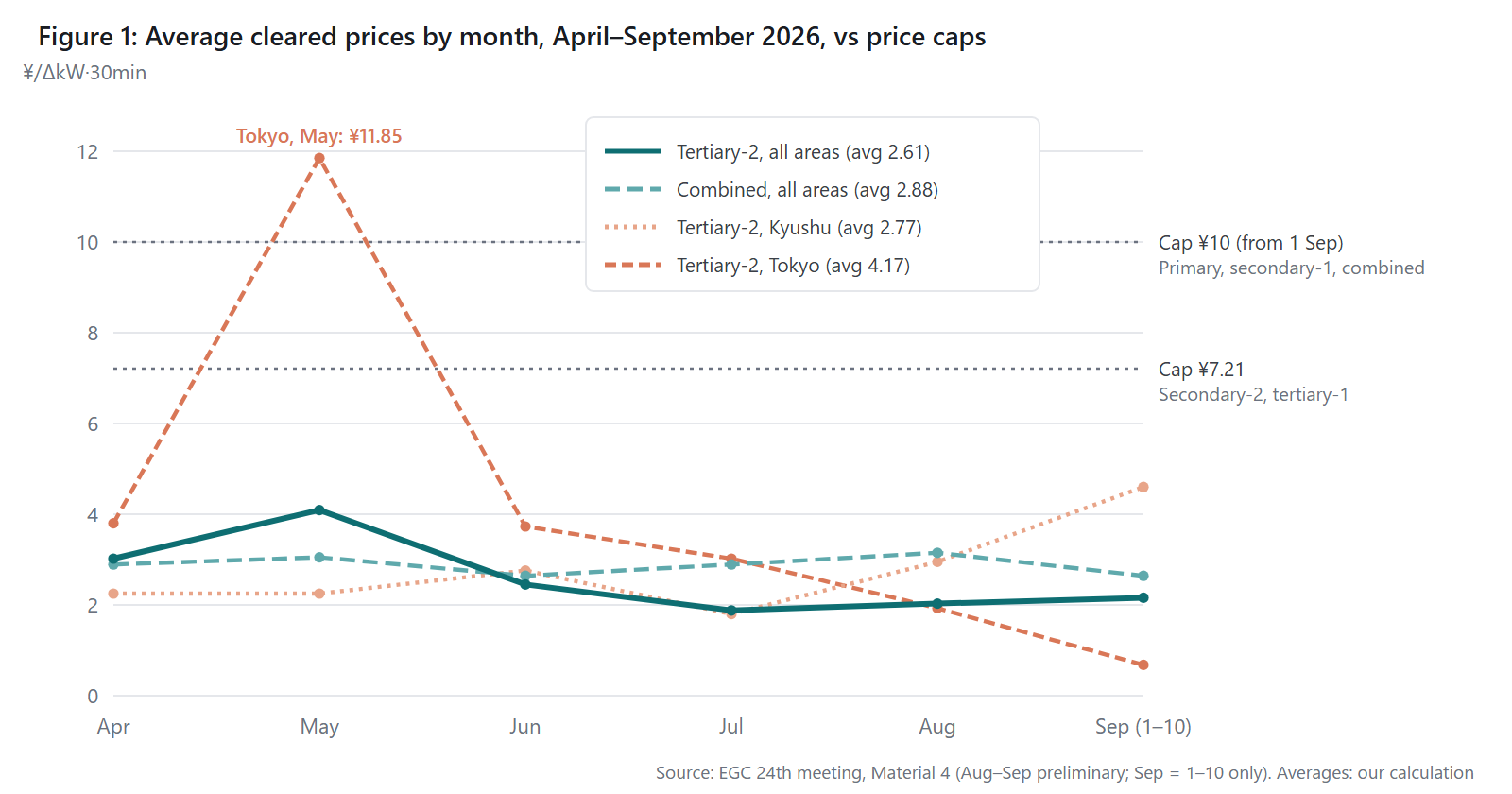
Monthly average cleared prices were as follows (¥/ΔkW·30min).
| Month | Tertiary-2, all areas | Tertiary-2, Tokyo | Tertiary-2, Kyushu | Combined, all areas |
|---|---|---|---|---|
| April | 3.02 | 3.80 | 2.25 | 2.89 |
| May | 4.09 | 11.85 | 2.25 | 3.05 |
| June | 2.45 | 3.73 | 2.76 | 2.64 |
| July | 1.88 | 3.02 | 1.80 | 2.89 |
| August (preliminary) | 2.03 | 1.93 | 2.95 | 3.15 |
| September (1–10, preliminary) | 2.16 | 0.68 | 4.60 | 2.64 |
| Six-month simple average | 2.61 | 4.17 | 2.77 | 2.88 |
Three points matter when reading these figures.
- The average cleared price is estimated cost divided by total cleared volume. Estimated cost is the sum of cleared price × cleared volume across all awarded bids.
- The all-area figure is a weighted average of the prices of the nine transmission and distribution companies.
- April to July are final figures. August and September are preliminary, and September covers 1–10 September only.
The "six-month simple average" row is our own calculation, a simple average of the monthly figures. It is not a value published by the EGC.
2. Areas differ widely: Tokyo reached ¥11.85 in May and ¥0.68 in early September
On the all-area average, tertiary-2 stayed within ¥2–4 a month. Broken down by area, the picture is quite different.
In the Tokyo area, the tertiary-2 monthly average rose to ¥11.85 in May, then fell to ¥3.73 in June, ¥3.02 in July and ¥1.93 in August, and was ¥0.68 in September (1–10 September). Kyushu moved the other way, rising from ¥1.80 in July to ¥2.95 in August and ¥4.60 in September (1–10 September).
For August, the EGC material notes that the tertiary-2 average cleared price rose from the previous month overall. By area, it fell in Hokkaido, Tohoku, Tokyo and Kansai, while in Hokuriku it rose to more than six times the previous month's level. Even within one market, prices move a long way with each area's required volume and bidding conditions.
The same material also lists, as events affecting required volumes by area, the start dates of negotiated contracts with pumped-storage hydro plants: Tohoku and Chubu on 1 April, Kansai on 4 April, Tokyo on 26 May and Chugoku on 10 June.
For a revenue estimate, use the figures for the area where the battery sits, not the all-area average.
3. With no cap on tertiary-2, some slots clear high (up to ¥97 in August)
Tertiary-2 has no price cap. Even when the monthly average is low, some slots can clear at high prices.
According to the EGC, the highest tertiary-2 cleared price in August was unchanged from July for the market as a whole, but more than doubled in Chubu (¥42.64 → ¥97.00), Hokuriku (¥27.68 → ¥96.50) and Shikoku (¥28.89 → ¥96.50). Estimated procurement cost for August, the expected cost of procuring the reserve, rose to about 1.5 times July's level overall, driven by higher prices and larger cleared volumes.
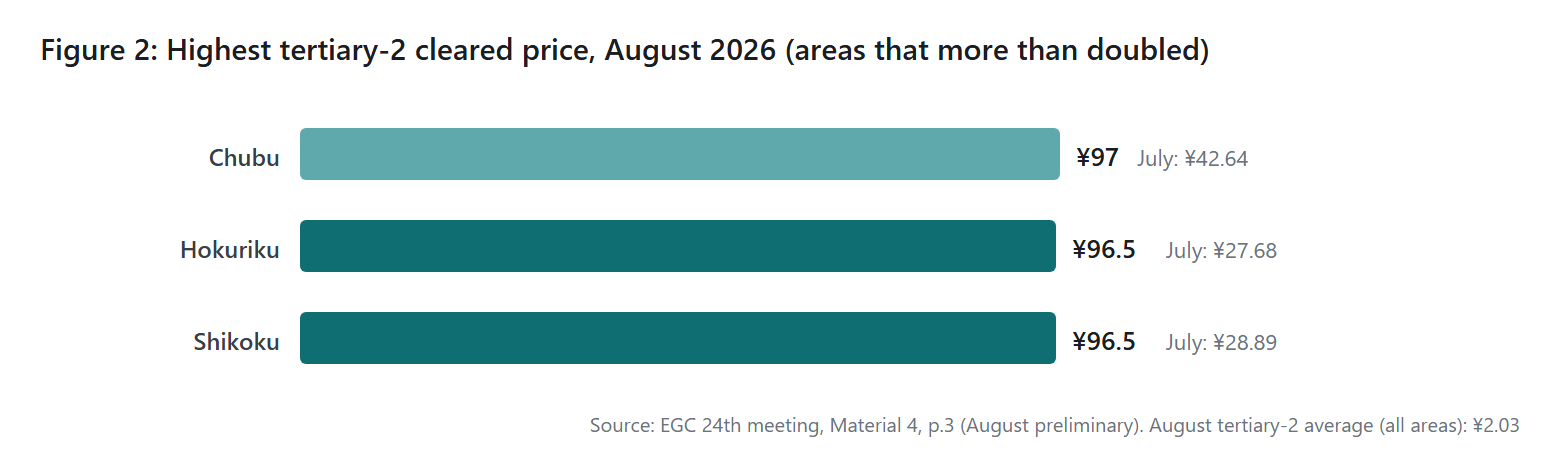
These high prices occurred in a limited number of slots. In the same month, the tertiary-2 monthly average across all areas was ¥2.03. Treating such spikes as an annual assumption badly overstates revenue.
4. Caps fell to ¥10 in September: caps by product, and what low-voltage batteries can bid
The price-cap update was decided after discussion at the Stable Power Supply Working Group on 14 July 2026 and announced by EPRX on 30 July 2026. From delivery on 1 September 2026, the cap for primary reserve, secondary reserve 1 and the combined market fell from ¥15 to ¥10/ΔkW·30min, for the time being. Secondary reserve 2 and tertiary reserve 1 remain at ¥7.21, and tertiary-2 has no cap.
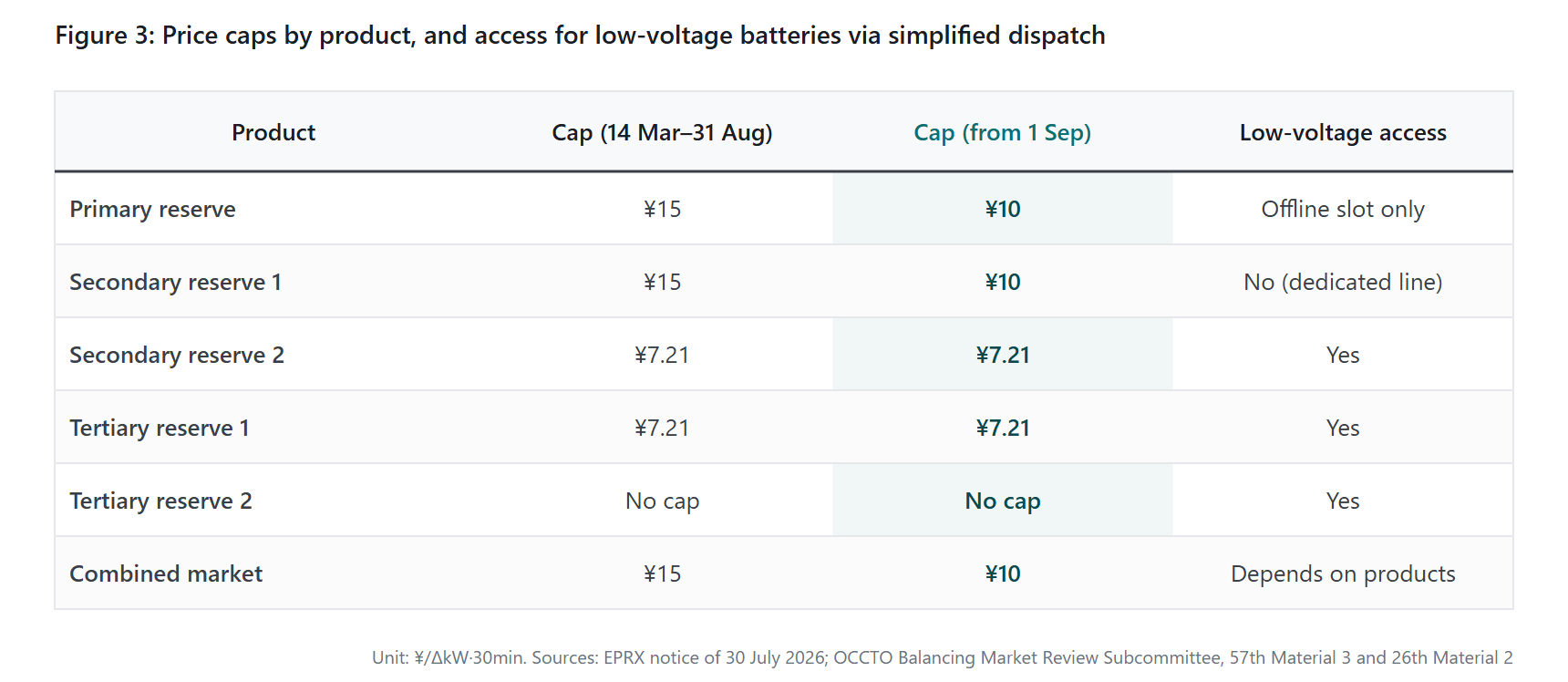
When low-voltage batteries are aggregated and bid through simplified dispatch instructions (簡易指令), the eligible products are secondary reserve 2, tertiary reserve 1 and tertiary reserve 2 (OCCTO, 57th Balancing Market Review Subcommittee, Material 3). Primary reserve also has an offline slot, which works without a dedicated communication line and with data submitted after the fact, but the slot has a size limit (same subcommittee, 26th meeting, Material 2). Secondary reserve 1 requires a dedicated line. Entering low-voltage resources as device-level points (機器点) under the representative contractor scheme is also limited to areas whose systems can support it (EPRX Trading Guide, 10th edition).
Of the three products open to low-voltage batteries, secondary reserve 2 and tertiary reserve 1 are capped at ¥7.21 and were not part of this cut. Tertiary-2 has no cap, and its actual monthly average has been ¥2–4, as the previous sections show.
How the price cap works, and how prices above the cap are treated, is covered in our explainer on the balancing-market price cap (Japanese).
5. How to put the gap between caps and actual prices into a revenue model
A battery's revenue from the balancing market is the cleared price multiplied by the awarded volume. For the same awarded volume, revenue is proportional to the price.
※ Calculation: ¥15 ÷ ¥2.61 ≈ 5.7, and ¥10 ÷ ¥2.61 ≈ 3.8. A model that assumes a price of ¥15 is pricing in about 5.7 times the revenue implied by the actual tertiary-2 average (all areas, simple average of April–September).
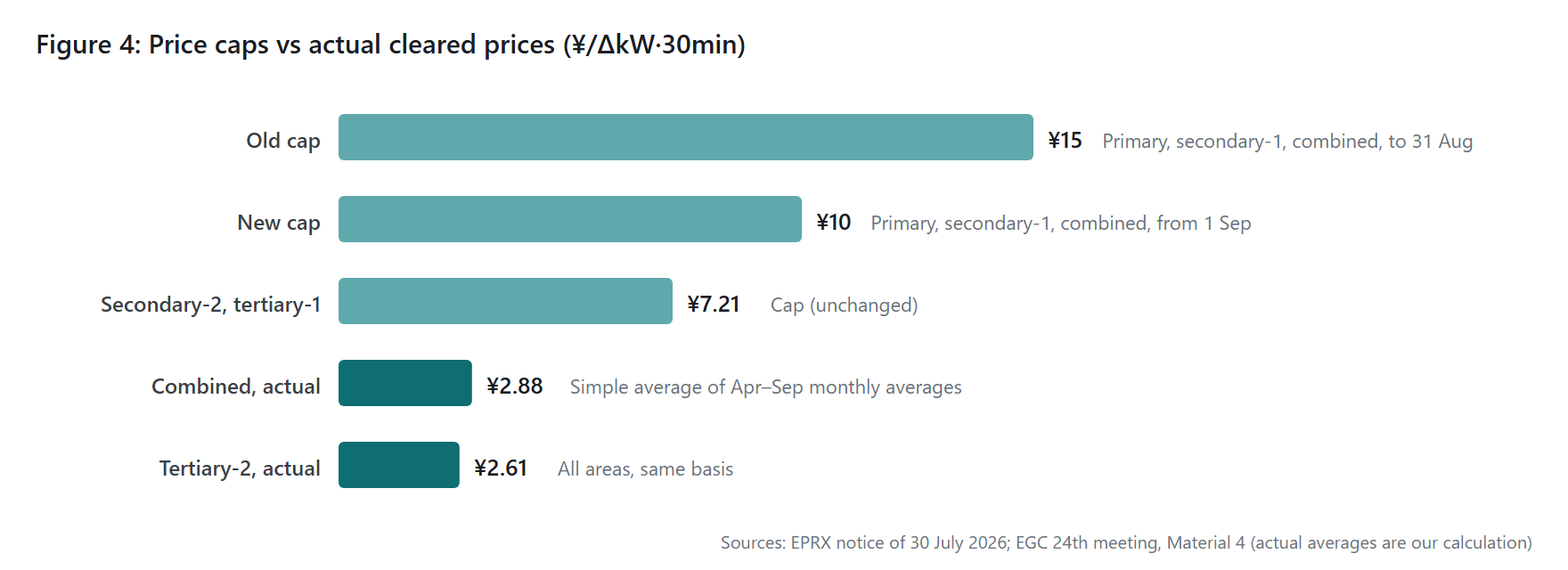
The price cap is a ceiling on the cleared price, and actual prices are set below it. On the April–September 2026 results, monthly averages sit far below the caps. A realistic model starts from actual results and works with a range.
Our 49.5kW low-voltage grid battery revenue simulation (Japanese) uses three cases for the tertiary-2 price: ¥2 conservative, ¥2.7 base and ¥4 upside. The ¥2.7 base sits between the six-month averages of tertiary-2 (about ¥2.61) and the combined market (about ¥2.88).
6. Primary reserve is still under-procured in many areas
The EGC reported required volumes, bid volumes and procurement rates for 1 April to 10 September 2026. Primary reserve was fully procured in the Hokkaido, Chugoku, Shikoku and Kyushu areas, but remains under-procured in many areas. In Chugoku, the required volume has been running high, partly because drought has constrained generation since early August and reduced the output of the pumped-storage plants held under negotiated contracts.
Where procurement falls short, primary-reserve bids are not reaching the required volume. That does not mean any battery can fill the gap. As the earlier section explains, low-voltage batteries using simplified dispatch can offer primary reserve only through the offline slot, which has a size limit. Read the primary-reserve procurement figures together with whether your own asset is eligible for the product.
7. The main rule changes of 2026
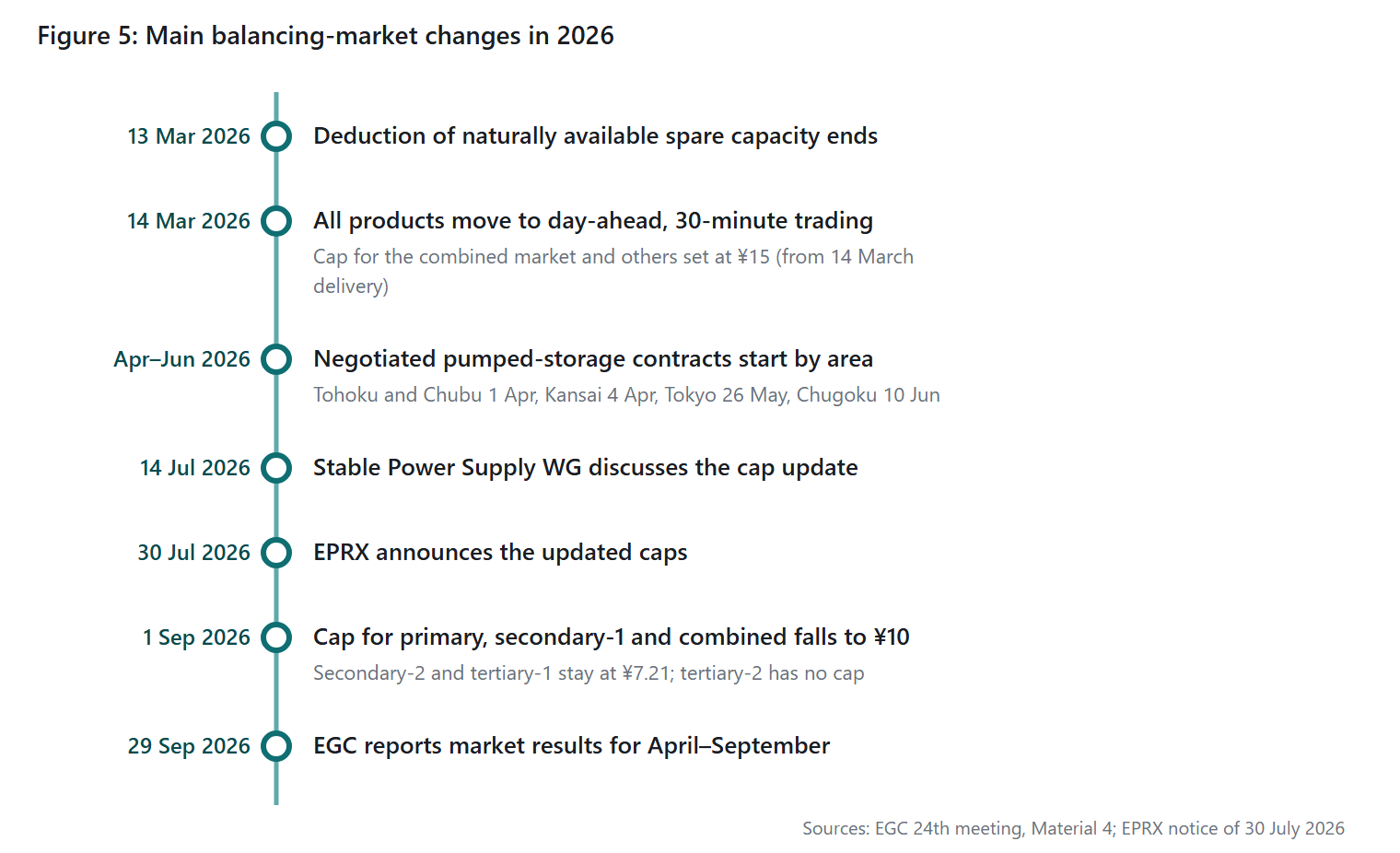
From the move to day-ahead, 30-minute trading in March 2026 to the price-cap cut in September, the balancing market's rules changed a great deal in six months. The price results should be read as figures produced after these changes. The March 2026 overhaul itself is covered in our article on Japan's 2026 balancing market overhaul.
8. What battery owners should keep in mind
- Base revenue estimates on actual cleared prices, not on the price cap. Actual prices also swing from month to month, so work with a range.
- Look at the figures for the area where the battery sits. Tokyo and Kyushu can move in opposite directions in the same month.
- August and September figures are preliminary, and September covers 1–10 September only. Final figures may differ.
- High-price slots occur in only part of the market. Do not build them into annual assumptions.
- Under-procurement of primary reserve means different things depending on whether your asset can take part.
- The latest developments are reported in the materials of the EGC's System Design and Surveillance Expert Panel.
LehmanSoft Japan provides operation services (aggregation) for grid-scale batteries. Our approach to operating across the balancing market, the wholesale power market and the capacity market is described on our operation service page.
Conclusion
In April–September 2026, cleared prices in Japan's balancing market averaged ¥1.88–4.09 a month for tertiary-2 (all areas) and ¥2.64–3.15 for the combined market. Actual prices were far below even the ¥10 cap that applies from September. At the same time, prices moved differently by area, and on tertiary-2, which has no cap, some slots cleared at ¥97.
When estimating battery revenue, start from actual cleared prices rather than the cap, and build in area differences, month-to-month swings and the preliminary status of recent figures. The numbers will be updated in future releases, so it is worth checking EGC and EPRX materials regularly.
References
- Electricity and Gas Market Surveillance Commission (EGC), "On the Operation of the Balancing Market" (需給調整市場の運用等について), Material 4, 24th meeting of the System Design and Surveillance Expert Panel (29 September 2026, in Japanese) https://www.egc.meti.go.jp/activity/emsc_systemsurveillance/pdf/024_04_00.pdf
- Electric Power Reserve eXchange (EPRX), notice on the price-cap update (30 July 2026, in Japanese) https://www.eprx.or.jp/j_information/docs/202607300000_news.pdf
- Organization for Cross-regional Coordination of Transmission Operators (OCCTO), 57th Balancing Market Review Subcommittee (需給調整市場検討小委員会), Material 3 (26 September 2025, in Japanese) https://www.occto.or.jp/assets/iinkai/chouseiryoku/jukyuchousei/2025/files/jukyu_shijyo_57_03.pdf
- OCCTO, 26th Balancing Market Review Subcommittee, Material 2 (in Japanese) https://www.occto.or.jp/assets/iinkai/chouseiryoku/jukyuchousei/2021/files/jukyu_shijyo_26_02.pdf
- Electric Power Reserve eXchange (EPRX), Trading Guide, 10th edition (1 July 2026, in Japanese) https://www.eprx.or.jp/outline/docs/guide_ver.10_260701.pdf
This article is based on public information as of 29 October 2026. August and September figures are preliminary, and September covers 1–10 September only. The six-month simple averages are our own calculation. Rules and prices may change without notice; for actual investment decisions, consult the latest primary sources and a qualified advisor.